Guide
Inflatables and wind: limits and anchoring
A giant inflatable is usually taken down once the wind passes 24 mph (38 km/h), force 5 on the Beaufort scale: that is the limit the UK’s Health and Safety Executive (HSE) sets for play inflatables, and the trade often uses it as a benchmark. Helium leaves less margin: below 15 mph, about 24 km/h, according to the manufacturer Glow Inflatables. For a custom piece, the maker sets the limit from its shape, height and anchoring.
Contents · 5 sections
How strong a wind can a giant inflatable stand outdoors?
The usual limit is 24 mph (38 km/h), force 5 on the Beaufort scale: the HSE sets it for play inflatables, and some models have a lower limit, given in the manufacturer’s manual.

The threshold covers play inflatables under BS EN 14960. For a custom advertising or art inflatable, its maker gives the limit of the piece, based on its shape, height and anchoring: ask for it in writing when you choose the manufacturer.
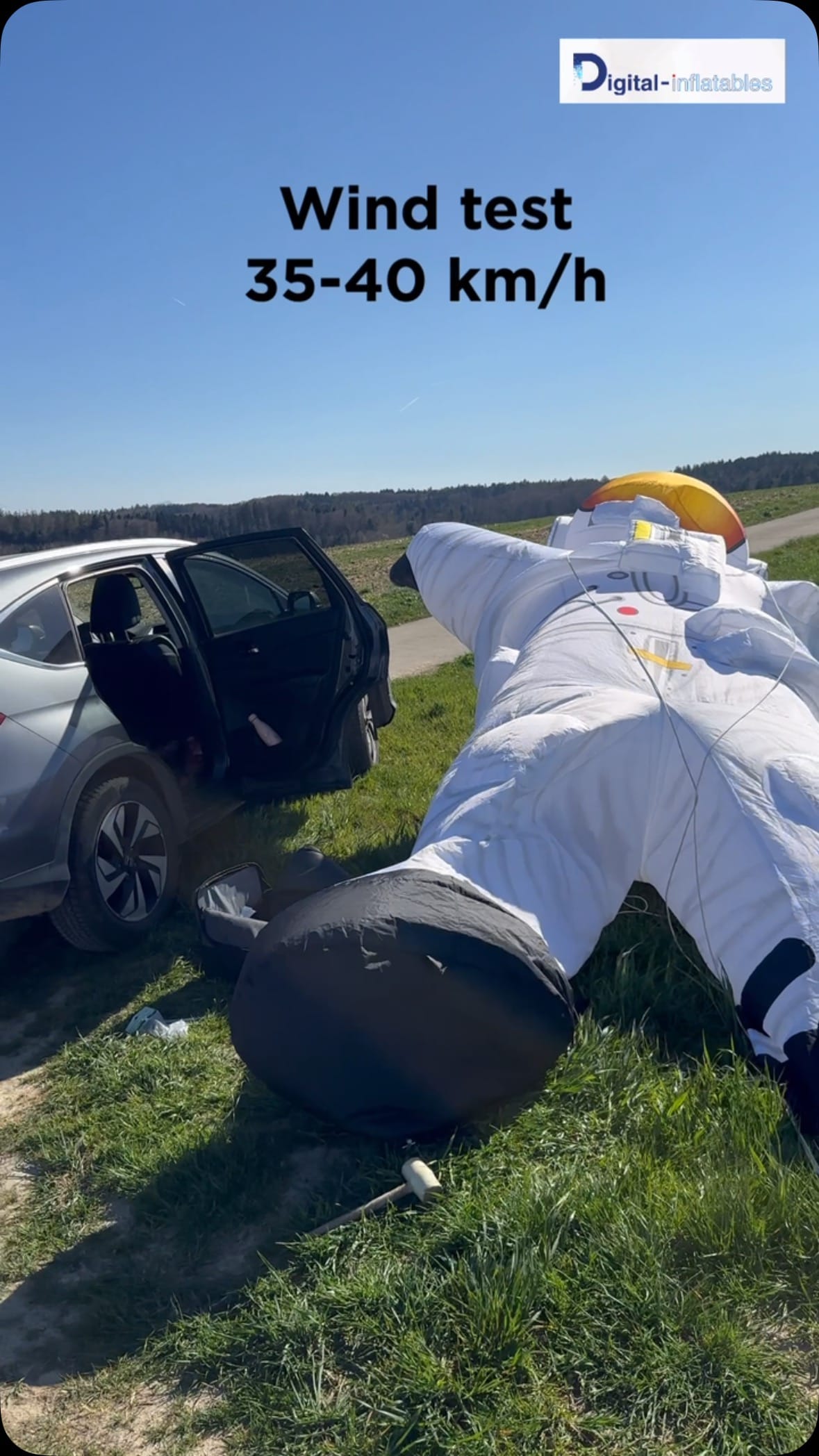
Digital Inflatables published a wind test at 35 to 40 km/h, around the 38 km/h limit: its 5 m inflatable astronaut ends up lying flat on the grass.
What does force 5 on the Beaufort scale mean?
The Beaufort scale ranks the mean wind by force; force 5, a fresh breeze, runs from 19 to 24 mph per the US National Weather Service, or 29 to 38 km/h per MeteoSwiss, when small trees in leaf begin to sway.
Force 4, moderate breeze: 13 to 18 mph (20 to 28 km/h). Force 5, fresh breeze: 19 to 24 mph (29 to 38 km/h). Force 6, strong breeze: 25 to 31 mph (39 to 49 km/h). Force 7, near gale: 32 to 38 mph (50 to 61 km/h).
These are mean speeds measured 10 m above open ground. Gusts go higher, so check the gust forecast, not only the mean wind.
In France, the town of Saint-Herblain counts gusts in its orders: with a forecast of 38 km/h and more, gusts included, no tent for under 19 people may go up, and those standing are taken down.
A similar project? Describe it to our team.
Request a quoteStakes or ballast: how do you anchor an inflatable on each surface?
On grass or soil, drive in metal stakes at least 380 mm long and 16 mm wide; on tarmac or concrete, use ballast of at least 163 kg per anchor point, according to the HSE.

The HSE requires every anchor point to be used, at least 6 per inflatable, so the wind cannot get under it and lift it. Ropes must be in good condition; improvised bungee cords are never acceptable.
For the PlanetSolar Foundation, Digital Inflatables built a 20 m inflatable dome whose 10 t of ballast is hidden inside the structure.
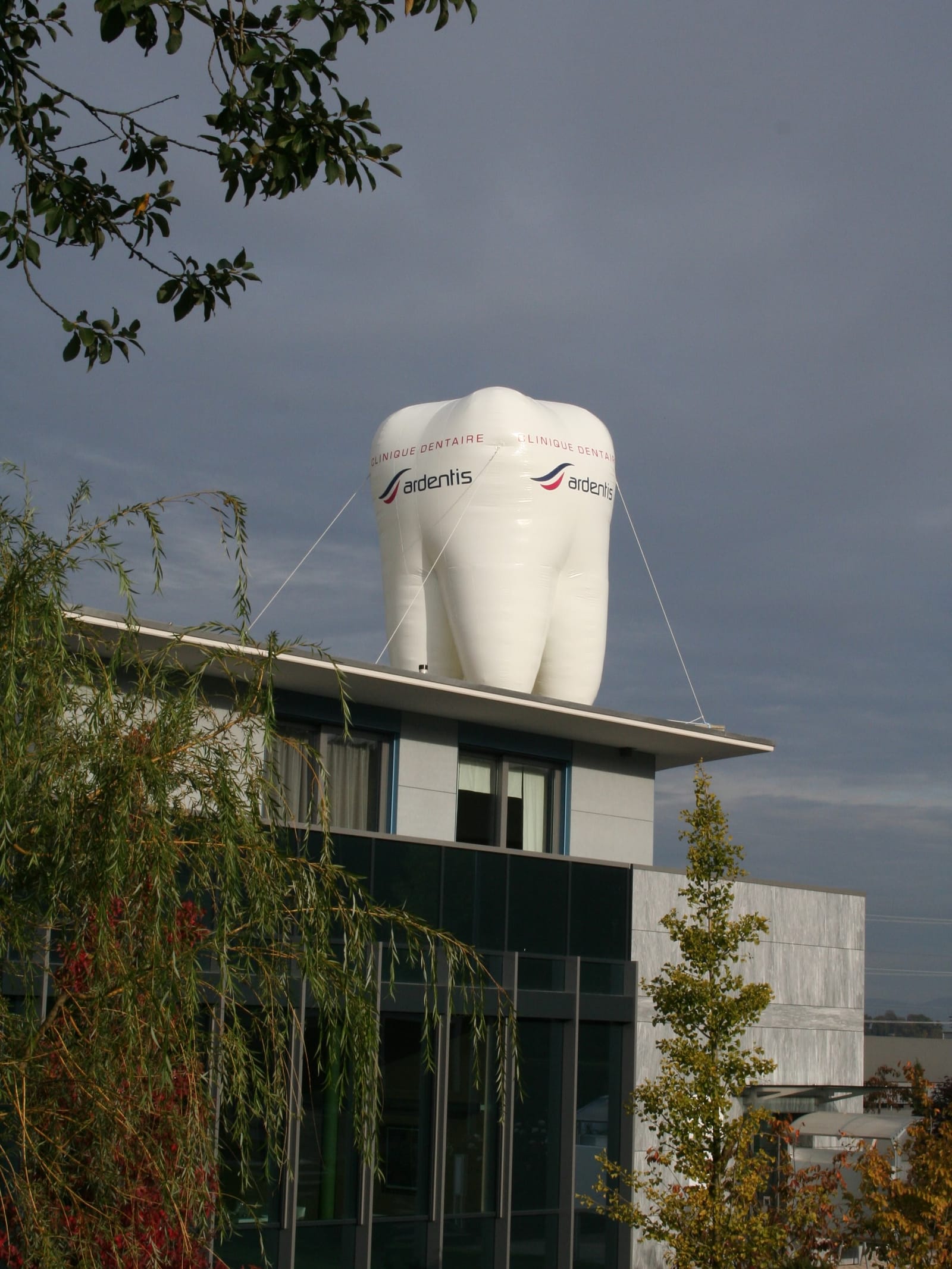
On a roof, the 6-metre inflatable tooth made for Ardentis is held by thin guy lines tied to anchor points.
Helium or air: what changes in the wind?
A constant-air inflatable sits anchored on the ground, kept under pressure by its blower; a helium inflatable floats on its tethers, and the manufacturer Glow Inflatables limits its outdoor use to winds and gusts below 15 mph, about 24 km/h.
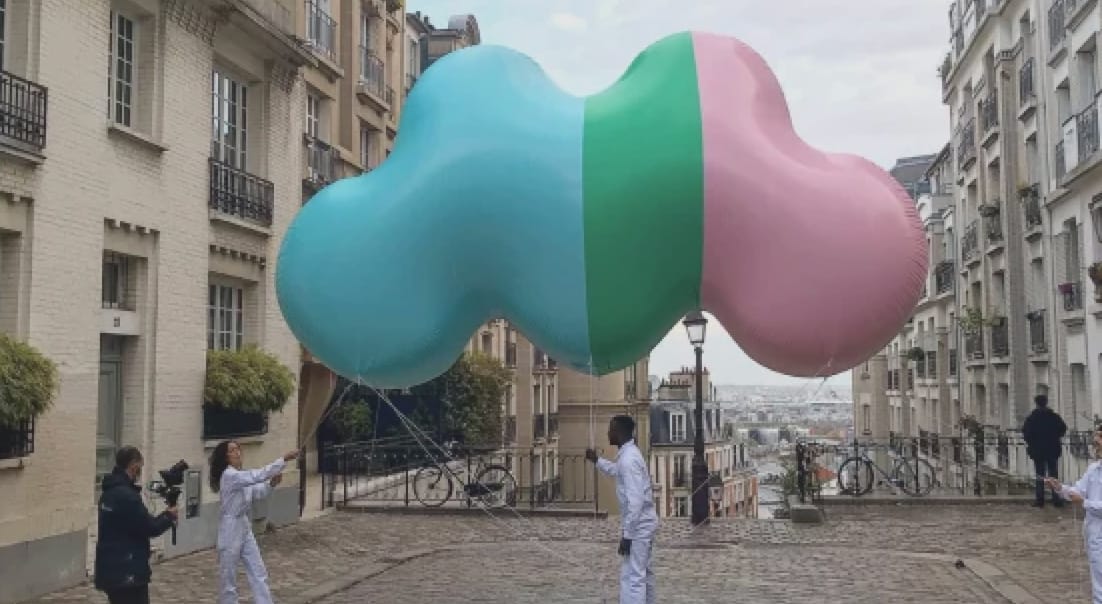
The 6 m helium cloud Digital Inflatables created for Mosaert was installed in Montmartre, Paris. In the pictures, several people guide it by its tethers above a cobbled street.
Under Swiss law, a captive balloon is an aircraft: the OACS bans those of 40 m³ or less flying less than 3 km from the runways of a civil or military aerodrome, unless air traffic control or the aerodrome manager grants an exception.
A constant-air inflatable depends on its blower: the PlanetSolar Foundation dome combines a dual pressure system with emergency power.
Who decides to take an inflatable down on the day?
On site, the operator measures the wind with an anemometer at regular intervals and deflates when the manual’s limit is reached; the HSE rules out phone weather apps and says not to operate outdoors without an anemometer.
The authority that grants the site can set its own thresholds: in Saint-Herblain, in winds of more than 70 km/h, structures holding more than 19 people are evacuated, and the organiser is responsible for their stability.
For an installation on public land, the conditions are set with the municipality that approves the event: confirm them with it before setting up, as the guide to permits for giant inflatables explains.
In Vevey, after setting up the 12 m grape for the Fête des Vignerons 2019, the team thanked the wind god for being so calm.
Full specifications
| Play inflatables, HSE limit | 24 mph (38 km/h), force 5 Beaufort |
|---|---|
| Helium inflatables, Glow Inflatables limit | below 15 mph, about 24 km/h |
| Force 5, fresh breeze | 19-24 mph (29-38 km/h) |
| Force 6, strong breeze | 25-31 mph (39-49 km/h) |
| Stakes on grass (HSE) | at least 380 mm long and 16 mm wide |
| Ballast on hard ground (HSE) | at least 163 kg per anchor point |
Frequently asked questions
What is the maximum wind speed for an inflatable?
The usual reference is 24 mph (38 km/h), force 5 on the Beaufort scale, set by the UK’s HSE for play inflatables; the manufacturer’s manual may set less.
How many mph is force 5 on the Beaufort scale?
19 to 24 mph per the US National Weather Service, or 29 to 38 km/h per MeteoSwiss, for the mean wind.
Can a helium balloon stay outdoors in strong wind?
No: the manufacturer Glow Inflatables limits outdoor use of giant helium inflatables to winds and gusts below 15 mph, about 24 km/h.
How do you secure an inflatable on concrete?
With ballast, since stakes cannot go in: the HSE asks for at least 163 kg per anchor point.
Do you need a permit for a tethered balloon in Switzerland?
With people on board, yes, from the FOCA; without occupants, the OACS bans balloons of 40 m³ or less near aerodromes, at less than 3 km from the runways, and the rest should be confirmed with the FOCA.
Sources
- HSE (gov.uk): play inflatables safety advice hse.gov.uk
- MeteoSwiss: Beaufort table meteoswiss.admin.ch
- Weather.gov: Beaufort wind scale weather.gov
- Glow Inflatables, FAQ glowinflatables.com
- Saint-Herblain town council: tent and wind order saint-herblain.fr
- Fedlex: ordinance on special category aircraft fedlex.admin.ch
- Digital Inflatables projects page digital-inflatables.com
Drafted with AI assistance from the company’s verified facts, reviewed and approved by Jodoc Elmiger, founder and managing director of Digital Inflatables.