Guide
How to commission a custom inflatable sculpture
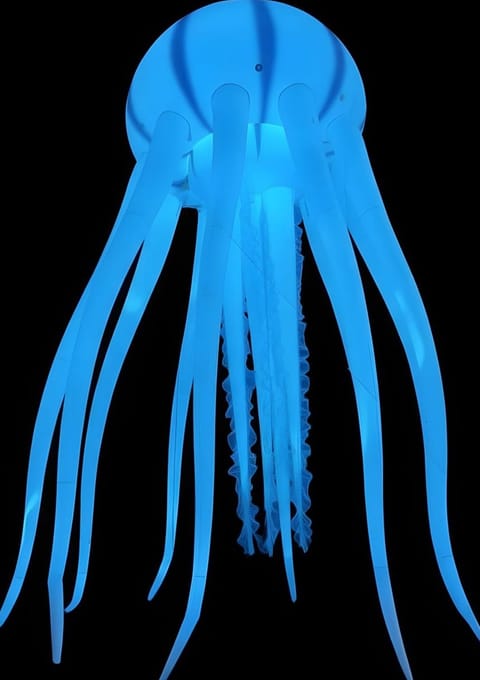
A custom inflatable sculpture such as a 10-metre jellyfish usually takes Digital Inflatables 6 to 8 weeks at minimum, from the initial phone call to installation; Claudia Comte’s took 3 weeks. The artist or museum supplies the drawing or 3D model and signs off the tests. In Switzerland, the author remains the natural person who created the work, even when the object changes hands.
Contents · 6 sections
How is an inflatable sculpture made, from sketch to installation?
The workshop starts from a sketch, a model or a 3D file, turns it into digital patterns, prints and cuts the fabric, assembles it, inflates it in the workshop, then installs it.
For the inflatable monsters made for the Netflix release of Spellbound, the chain ran from the full 3D design to digital production templates, sublimation printing, laser cutting and the assembly of 140 fabric pieces per element.
For the Sèvres Manufactory, Digital Inflatables designed, built and installed 4 structures of 3 and 6 metres conceived by studio GGSV, in 10 days.
Collaborations can last: for artist Tine Bech, the workshop made the pear of The World Has Gone Pear Shaped, shown at Light Night Leeds in 2023, then an inflatable cloud for Winter Lights Canary Wharf in London.
Do you need a prototype before the artwork is made?
For a new shape, finish or mechanism, yes: a fabric test, a small model or an inflation test avoids surprises on the final piece.
Before offering mirror spheres, Digital Inflatables ran tests with mirror fabric and tested a 2 m mirror ball. For its mirror balloons, the workshop also ran its own flame test on top of the paper certificate.
For Hala Amer’s breathing artwork, the breathing function only concerns part of the structure, and the project was completed in five weeks. A movement like this is tuned by trial: rhythm, amplitude and blower noise matter as much as the shape.
The prototype also checks printed colours, seams and internal lighting under the real light of the venue.
A similar project? Describe it to our team.
Request a quoteWho owns the rights to an inflatable artwork, and how is the workshop credited?
The artist: in Switzerland, the author is the natural person who created the work, and selling the object does not transfer the copyright; in France, a commission contract does not change this either.
The artist has the right to be recognised as the author and to choose the name under which the work is shown; they also decide whether and how it may be altered, which matters for a retouch, a reprint or a new version.
The production contract settles the rest: how the workshop is credited, its right to show the work in its portfolio, ownership of the 3D files and patterns, and who may order a copy.
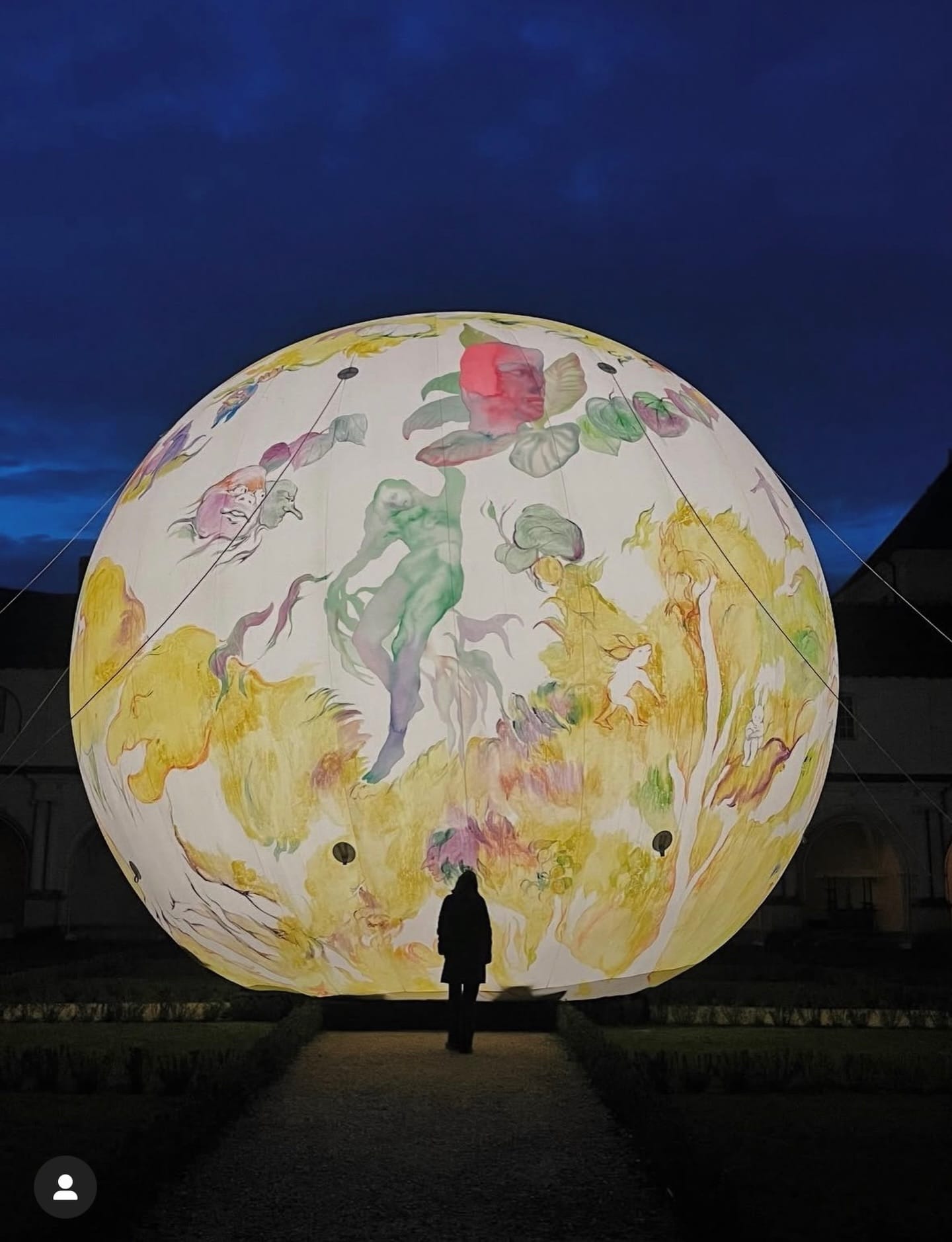
In Sèvres, the installation is signed by Parisian studio GGSV, and Digital Inflatables designed, built and installed the inflatable structures. For Makiko Furuichi, the 9-metre sphere was partly printed, then painted by the artist herself.
How do you store an inflatable artwork between exhibitions?
Clean, completely dry, folded with smooth interleaving sheets and kept cool, dry and dark: the Canadian Conservation Institute recommends relative humidity below 65% and lighting of 150 lux at most for plastics.
PVC is particularly prone to plasticiser loss; where a fold is unavoidable, the CCI advises interleaving smooth non-stick sheets, such as polyethylene, and avoiding contact with paper and foam.
A check at least once a year will pick up an odour, a sign that the material is releasing volatile compounds and should be kept apart. Cleaning, drying and repair are covered in the guide to inflatable lifespan and care.
Makiko Furuichi’s sphere, on show at the Abbaye de Fontevraud until March 2026, is announced for SPOT in Vernon from 18 September to 5 December 2026.
In Switzerland, the owner of the only original may not destroy it without first offering it back to the author, where the author has a legitimate interest in its preservation.
How do you keep the public safe around an inflatable artwork?
With calculated anchoring, wind monitoring and a clear shutdown rule: in 2006, Dreamspace V, an inflatable artwork by Maurice Agis that was not securely tied down, was lifted by wind gusts with visitors inside, and 2 people died.

For play inflatables, the UK Health and Safety Executive (HSE) sets the operating limit at 24 mph (38 km/h) and asks for the wind to be measured with an anemometer. An artwork follows its own engineering, but these figures help set the shutdown rule; see the guide to wind limits and anchoring.
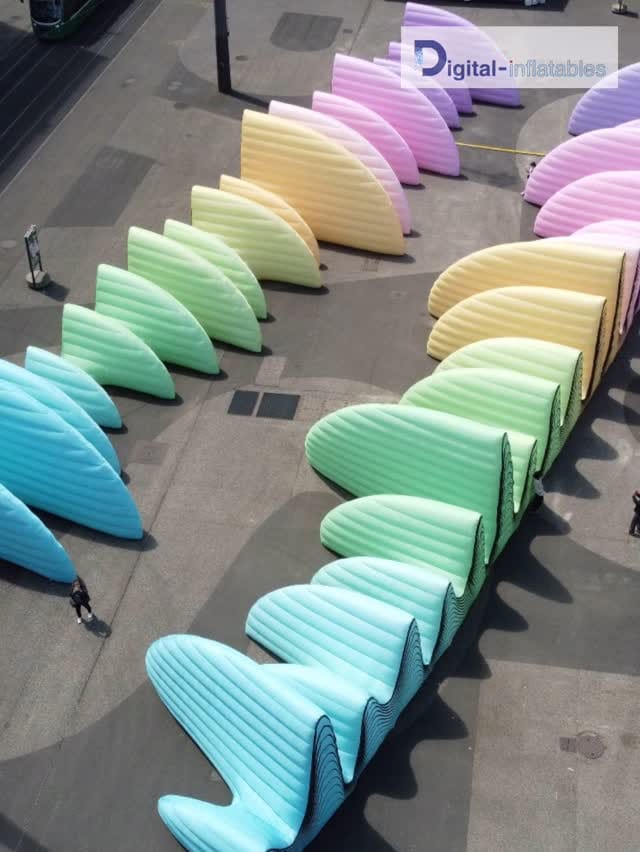
A walk-through work demands more: Lightning Symphony, a walkable 55-metre inflatable sculpture, stood on the Messeplatz in Basel during the Eurovision Song Contest 2025. The HSE asks for a test before each use that the structure deflates slowly enough, in a power cut, for everyone to get out.
Indoors, the fabric must also meet the venue’s fire rules: in Switzerland, decorations in rooms open to the public are made of RF2 materials, or RF3 (cr) in rooms with sprinklers. Ceiling height, rigging and blower noise are covered in the guide to using inflatables indoors.
What budget and lead time for a site-specific piece?
Lead times range from days to a year: 10 days for the 4 structures in Sèvres, five weeks for Hala Amer’s artwork, usually 6 to 8 weeks at minimum for a 10-metre jellyfish, and a year of work for the 18-metre sphere at the MAH in Geneva.
On budget, Digital Inflatables quoted artists prices from $600 per metre in 2024, with a free quote and worldwide delivery; Anna Lomax’s 8 m sculpture was shown in London.
A piece can also come from a partnership: Makiko Furuichi’s sphere was made to support the work of the artist and of the venue.
For a site-specific piece, also budget for the site survey, rigging or ballast, power for the blower and the venue’s approval of the fire rating. Observed price ranges are in the guide to custom inflatable prices.
Full specifications
| Author of the work | the natural person who created it (Switzerland, CopA, art. 6) |
|---|---|
| Selling the object | does not transfer the copyright (Switzerland, CopA, art. 16) |
| Usual lead time for a 10 m jellyfish | 6 to 8 weeks at minimum |
| Claudia Comte’s jellyfish, from call to installation | 3 weeks |
| Storing a plastic artwork | relative humidity below 65%, cool and dark (CCI) |
| TonUtopie sphere, MAH Geneva | 18 metres (59 ft) across, a year of work |
Frequently asked questions
How long does it take to make an inflatable sculpture?
Usually 6 to 8 weeks at minimum for a 10-metre jellyfish, according to Digital Inflatables; that project took 3 weeks, with some luck.
Who is the author of an inflatable sculpture made by a workshop?
Under the law of Switzerland, the natural person who created the work, usually the artist; how the workshop is credited is set by contract.
Does a museum that buys an inflatable artwork own the rights?
Not automatically: in Switzerland, transferring ownership of a work, even the original, does not transfer the copyright.
How should an inflatable artwork be stored between exhibitions?
Clean, dry, folded with smooth interleaving sheets, in a cool, dark room with relative humidity below 65%.
Can an inflatable artwork be shown outdoors?
Yes, with calculated anchoring and a shutdown rule for strong wind: Makiko Furuichi’s sphere stood at the Abbaye de Fontevraud.
How much does an inflatable sculpture cost?
Digital Inflatables quoted artists prices from $600 per metre in 2024; the final price depends on the shape, the print and the deadline.
Sources
- Copyright Act (CopA), Switzerland [[author_ch_lda_en]] fedlex.admin.ch
- Légifrance, Intellectual Property Code, art. L111-1 [[commission_fr_cpi_en]] legifrance.gouv.fr
- Canadian Conservation Institute, Notes 15/1 [[plastics_environment_cci_en]] canada.ca
- Wikipedia, 2006 Dreamspace V incident [[dreamspace_accident_en]] en.wikipedia.org
- HSE, play inflatables safety advice [[blower_deflation_hse_en]] hse.gov.uk
- Latele.ch, TonUtopie at the MAH in Geneva [[tonutopie_mah_en]] latele.ch
- Digital Inflatables Instagram post on Claudia Comte’s jellyfish [[#9f40998a-40f4-48f6-a195-3f127fa34a31]] instagram.com
- Digital Inflatables projects page digital-inflatables.com
Drafted with AI assistance from the company’s verified facts, reviewed and approved by Jodoc Elmiger, founder and managing director of Digital Inflatables.