Guide
Glossary of custom inflatable structures
A custom inflatable structure is an object made of coated fabric or film that holds its shape with air blown in continuously, with air sealed inside or with helium. This glossary defines the trade’s terms by theme: inflation, fabrics, printing, production, fire ratings and standards, object types and installation. For example, NFPA 701 is the fire test standard for textiles and films in the United States.
Contents · 7 sections
Inflation: what do constant air, sealed air and helium mean?
An inflatable keeps its shape with air blown in continuously, with air sealed inside or with helium, a gas lighter than air; the constant-air vs sealed vs helium guide compares these methods.

Constant air: an electric blower pushes air in non-stop to replace the air lost through the seams, and the inflatable deflates as soon as it stops. For the WAY agency moons, Digital Inflatables quotes a blower of just 120 watts (inflation methods guide).
Sealed air: the inflatable is filled once, closed with a valve, and stands without a power socket or blower noise. The Haut-Bugey Agglomération totems inflate this way with a small 12 V pump, without a 220 V socket (inflation methods guide).
Helium: a gas lighter than air that makes the inflatable float; one litre of helium lifts 1.02 g, envelope included (inflatable projection sphere guide).
Pressure: the push of blown or sealed air that tensions the fabric and gives the inflatable its shape; too low and the shape sags, too high and the seams and welds are strained (inflation methods guide).
Captive balloon: a helium balloon held to the ground by tethers; in Switzerland, the OACS forbids flying one of up to 40 m³ within 3 km of an aerodrome’s runways, unless an exception is granted (guide to permits in Switzerland).
Fabrics: what do PVC, coated polyester, denier, ripstop and TPU mean?
The fabric depends on the inflation method, indoor or outdoor use and the fire rating required; the inflatable fabrics and printing guide compares the options.

PVC: a fully waterproof plastic, used as a film or as a coating on a polyester base, which may contain fire-retardant and anti-UV additives; nylon, by contrast, is only water-resistant (fabrics guide).
Coated polyester: a polyester fabric with a layer of PU or PVC that makes it water- and airtight; at Michelin Inflatable, a PU-coated polyester certified M1 weighs 150 g/m² (fabrics guide).
Denier (D): the mass in grams of 9000 metres of yarn; a 300D polyester is light, a 600D heavy, but denier says nothing about airtightness or fire rating (fabrics guide).
Ripstop: a weave with crossed threads in a grid; if the fabric tears, the small squares contain the tear and stop it spreading (fabrics guide).
TPU, or thermoplastic polyurethane: a flexible material that resists abrasion and wear, with some grades as clear as glass (fabrics guide).
Drop stitch: a dual-wall fabric whose two woven layers are joined by drop yarns that keep it flat when inflated. Digital Inflatables has tested a mass-production drop-stitch fabric on an inflatable cube (fabrics guide).
A similar project? Describe it to our team.
Request a quotePrinting: what do dye sublimation, UV printing and Pantone mean?
Printing gives the inflatable its colours, lettering and logos, usually on the flat pieces before assembly; the inflatable fabrics and printing guide explains each process.

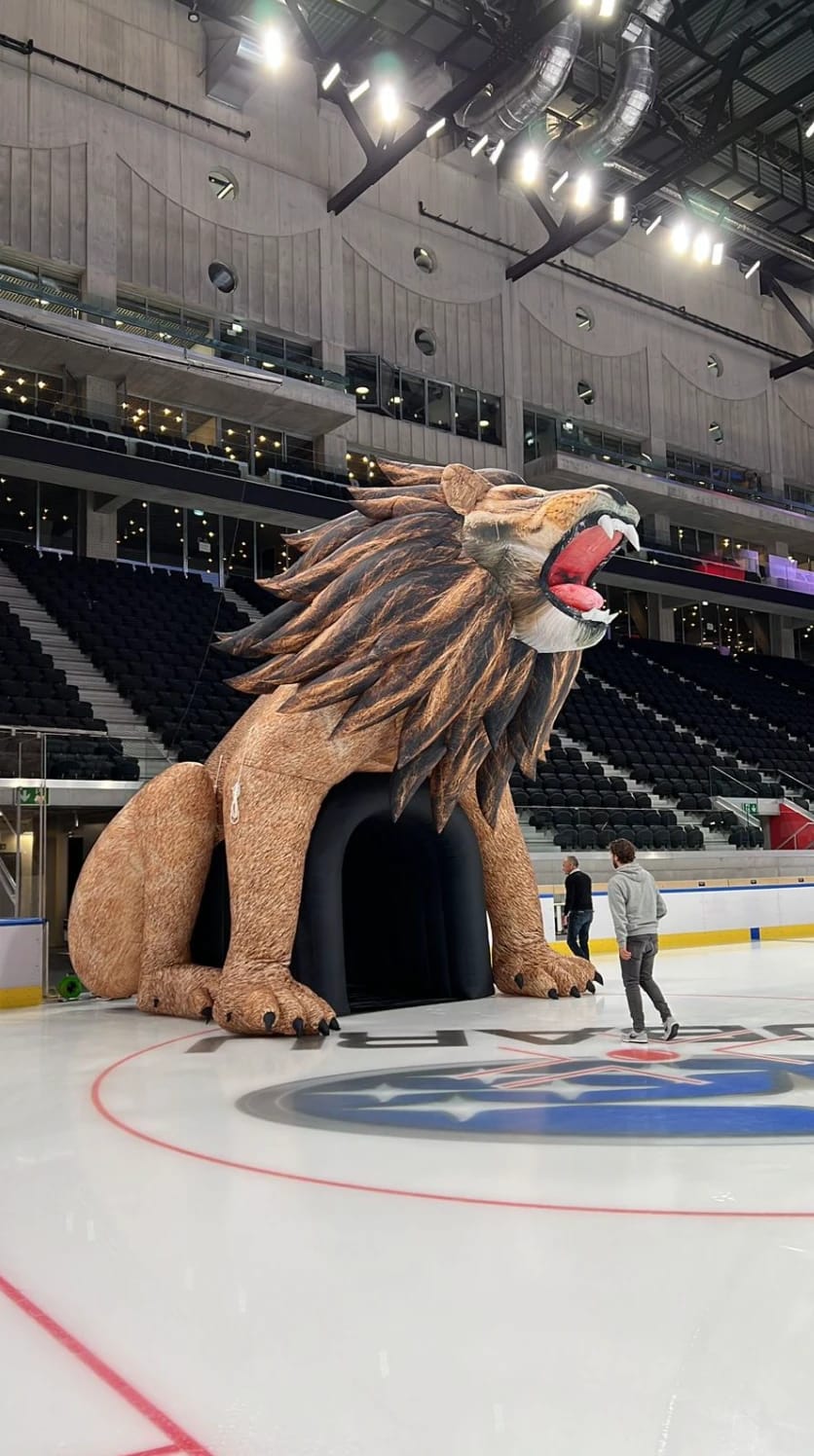
Dye sublimation: ink is printed on transfer paper, then heat-pressed onto a polyester fabric with no pre-treatment, and the print does not crack. The ZSC lion tunnel and the GSHC eagle tunnel were printed this way (fabrics and printing guide).
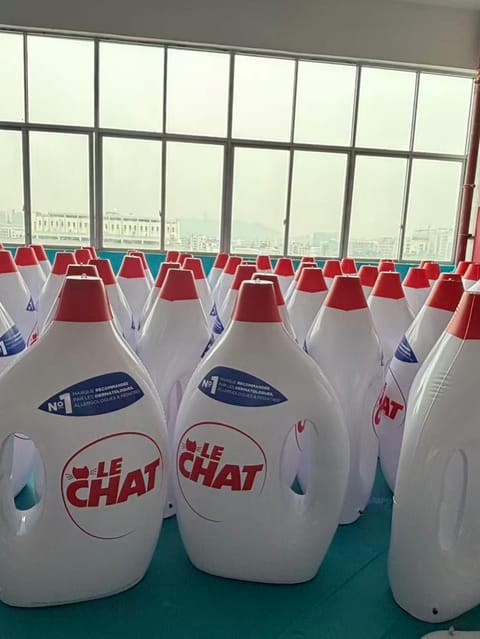
UV printing: an ink cured by UV light, dry as it leaves the printer and printable on PVC; the LE CHAT replica received a high-definition UV print (fabrics and printing guide).
Pantone: a colour reference system that reproduces a brand colour when the reference is supplied during design; a CMYK file also works, but the printed colour may differ from the screen (briefing guide).
Vector file: an SVG, AI, EPS or PDF file that keeps sharp outlines at any size; a JPEG or PNG image needs at least 150 dpi at full scale (briefing guide).
Velcro panel: a removable banner fixed with Velcro, which lets you change the visual from one event to the next, while a full print covers the whole surface (fabrics and printing guide).
Production: what do 3D model, proof, pattern and laser cutting mean?
These terms describe the path from idea to object: 3D model, sign-off, flat pieces, cutting and assembly, explained step by step in the guide to how custom inflatables are made.

3D model: the digital model of the object, showing shape, proportions and colours before production; for the ZSC lion tunnel, Digital Inflatables presented 3 proposals in 3D after 2 weeks (production guide).
Proof: the version the client approves before production; for the LE CHAT replica, design and the 3D proof took 3 days (production guide).
Pattern or digital template: a fabric piece unfolded flat from the 3D model; for the Spellbound monsters, the workshop created digital production templates (production guide).
Laser cutting: a laser beam cuts each piece and seals the edge of polyester fabrics, which then do not fray; the giant cat for a DJ club in Miami was cut on a plotter instead, a machine that follows the pattern (production guide).
High-frequency welding: a high-frequency field melts the plastic from the inside, between electrodes, to join materials such as PVC or PU; seams are enough for shapes kept inflated by a blower (production guide).
Safety and standards: what do M1, B1, AEAI RF1, EN 13501-1 and NFPA 701 mean?
Indoors, the fabric often has to prove its reaction to fire with a classification report, and each country has its own classes; other standards cover play equipment, tents or wind. The inflatable fire rating guide compares the classes.
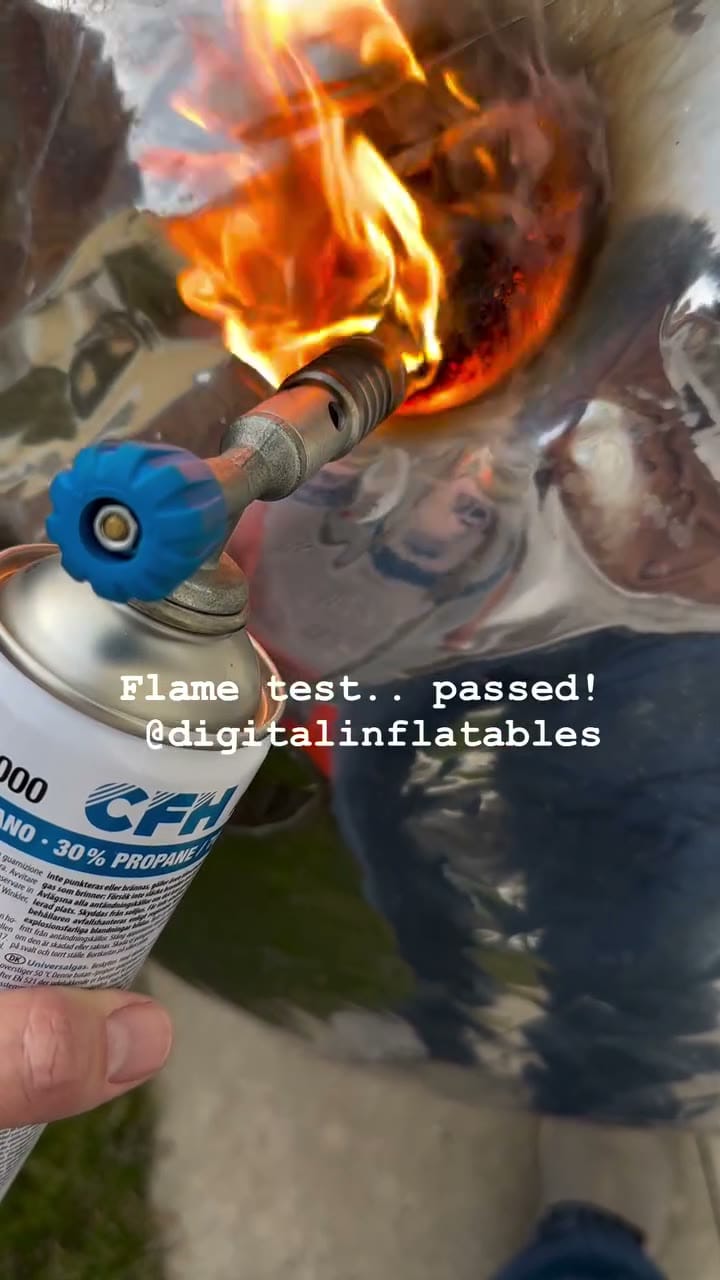
M1: in France, a non-flammable but combustible material under the NF P92-507 standard, which runs from M0 to M4 (fire rating guide).
Classification report: the document from an approved laboratory that proves a fabric’s fire class; in France it is valid for five years for the tested product, and a test report does not replace it (fire rating guide).
B1: in Germany, the class of flame-retardant materials under DIN 4102, required for decorations in places of assembly (fire rating guide).
AEAI RF1: in Switzerland, the AEAI/VKF fire protection directive 13-15 ranks materials from RF1, no contribution to fire, to RF4, unacceptable contribution (fire rating guide).
Standard EN 13501-1: the reaction-to-fire classification, with classes from A1 to F, smoke from s1 to s3 and flaming droplets from d0 to d2 (fire rating guide).
NFPA 701: the NFPA standard for fire tests on textiles and films, with one method for materials up to 700 g/m² (21 oz/yd²) and another above that weight (fire rating guide).
Standard EN 14960: the standard for inflatable play equipment for children fourteen years and under, used for bouncing and sliding; it covers play, not advertising or art inflatables (fire rating guide).
Beaufort scale: the scale of wind force; force 5, a fresh breeze, runs from 29 to 38 km/h, or 19 to 24 mph (inflatables and wind guide).
Object types: what do replica, mascot, tunnel, arch and dome mean?
Custom inflatables are grouped by shape and use; each type has its own page with Digital Inflatables projects.
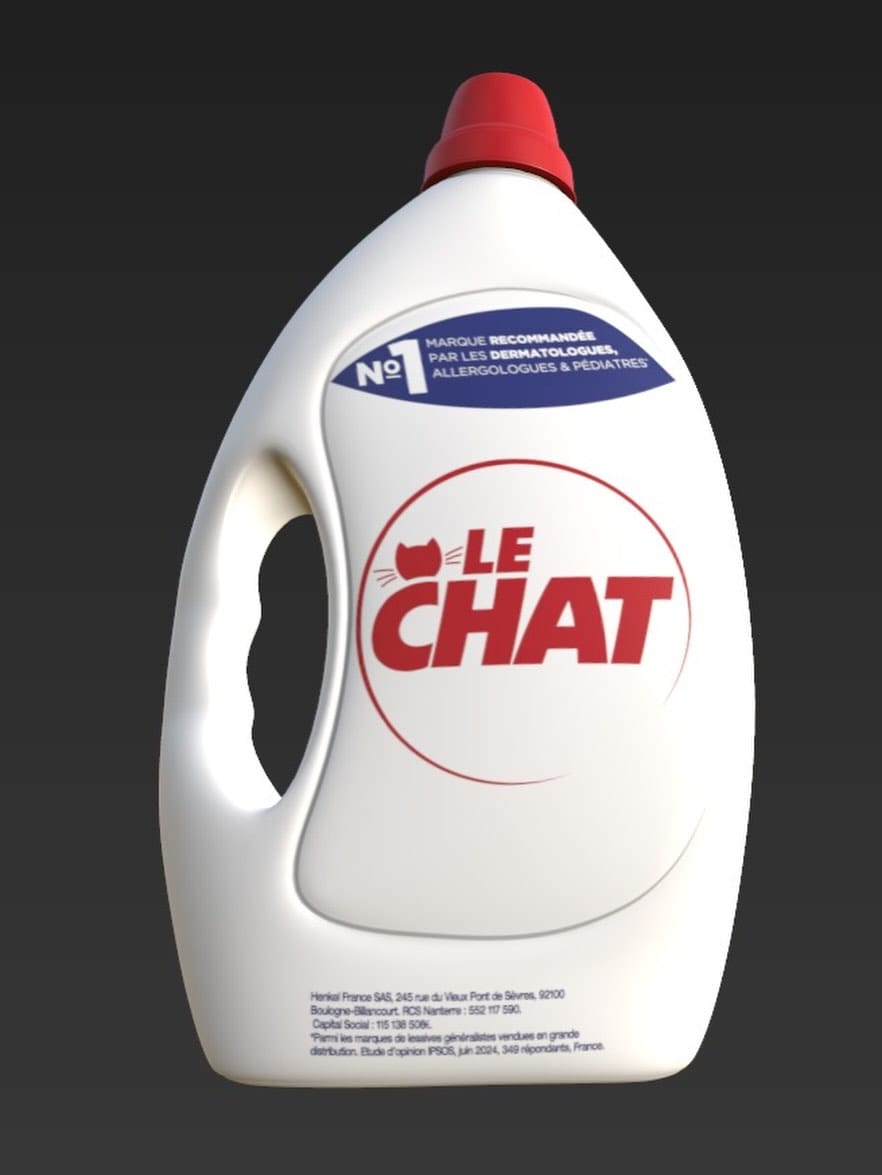
Product replica: a giant copy of a product or packaging, like the 1.3 m LE CHAT bottle placed in 100 supermarkets for Henkel (giant inflatable product replicas).
Mascot or character: a giant figure, animal or brand character, like the 7.5 m mascot of Busan’s bid, set on a boat on the Seine (giant inflatable mascots and characters).
Player tunnel: a tunnel inflated by an external blower, usually 3 to 9 m (10 to 30 ft) long, through which players enter the pitch or the ice (custom inflatable sport tunnels).
Arch: a gateway that marks a start, a finish or an entrance; the canton of Graubünden lends one 8 m wide and 6 m high that needs a 230 V connection (custom inflatable arches).
Dome or tent: a shelter whose structure is held up by air; the EN 13782 standard covers mobile tents with more than 50 m² of ground area, and the 20 m dome of the Fondation PlanetSolar has a dual pressure system (inflatable event domes and tents).
Sphere or balloon: a round shape, standing, hanging or filled with helium, that can be lit from inside, like the backlit Astra Festival moon (giant inflatable spheres).
Installation: what do ballast, anchoring and rigging point mean?
On site, an inflatable is held down by ballast or stakes, or hung from rigging points; at Beaugrenelle, more than 30 inflatables were installed in 6 hours, overnight.
Ballast: a weight that holds the inflatable on hard ground where no stake can be driven in; for play inflatables, the HSE requires at least 163 kg per anchor point (inflatables and wind guide).
Anchoring and stakes: the points where the inflatable is tied to the ground; the HSE requires at least 6 anchor points per play inflatable and metal stakes at least 380 mm long (inflatables and wind guide).
Rigging point: the point on a roof structure or ceiling from which an inflatable hangs; under the Swiss rigging guideline, the venue operator declares the permitted loads of these points (using inflatables indoors guide).
Floor area and clear height: the space available and the height free of obstacles on site, to be measured with the width of doorways before design (briefing guide).
Full specifications
| Denier (D) | mass in grams of 9000 metres of yarn |
|---|---|
| M1 (France) | non-flammable but combustible, under NF P92-507 |
| B1 (Germany) | flame-retardant, under DIN 4102 |
| RF1 (Switzerland, AEAI) | no contribution to fire |
| Helium lift | 1.02 kg per cubic metre, envelope included |
| Player tunnel | usually 3 to 9 m (10 to 30 ft) long |
Frequently asked questions
What is the difference between sealed air and constant air?
A constant-air inflatable stays up as long as its blower runs; a sealed-air inflatable is filled once, then closed, and stands without a socket, like the Haut-Bugey Agglomération totems.
What does M1 mean on an inflatable fabric?
It is the French class for a non-flammable but combustible material under NF P92-507, proven by a classification report.
What does 600D mean on a fabric?
A yarn of 600 denier, that is 600 grams per 9000 metres of yarn: a heavy polyester.
Does EN 14960 apply to advertising inflatables?
No: it covers inflatable play equipment for children, used for bouncing and sliding.
What is dye-sublimation printing?
A print where ink on transfer paper is heat-pressed onto a polyester fabric; it does not peel or crack.
Which fire rating applies in Switzerland?
An AEAI/VKF class from RF1 to RF4; for decorations in rooms open to the public, directive 12-15 requires RF2 materials, or RF3 (cr) in rooms with sprinklers.
Sources
- Digital Inflatables projects page digital-inflatables.com
- Digital Inflatables Instagram post instagram.com
- Digital Inflatables Instagram post instagram.com
- Fedlex, ordinance on special category aircraft fedlex.admin.ch
- UCSB Physics, helium lift web.physics.ucsb.edu
- Glow Inflatables FAQ glowinflatables.com
- Serge Ferrari, expertise and technologies sergeferrari.com
- Michelin Inflatable, structural fabrics inflatable.michelin.com
- QUDT, denier unit qudt.org
- Inflatable tunnel buyer’s guide (mvpvisuals.com) mvpvisuals.com
- Ripstop fabric patent (Google Patents) patents.google.com
- Dual-wall fabric patent (Google Patents) patents.google.com
- BASF, Elastollan for films and textiles plastics-rubber.basf.com
- Epson, dye-sublimation printers epson.eu
- Mimaki, UV-curable inks mimaki.com
- Hellopro, advertising inflatable prices conseils.hellopro.fr
- Zünd, laser module zund.com
- Kiefel, high-frequency welding kiefel.com
- IFTH, rules for textiles in public buildings textile.fr
- City of Griesheim, leaflet on places of assembly griesheim.de
- VKG, fire protection directive on building materials services.vkg.ch
- VKG, fire protection directive on fire prevention services.vkg.ch
- NFPA, revision of the standard for textiles and films docinfofiles.nfpa.org
- SNV, play inflatables standard connect.snv.ch
- Standards.ie, tents standard abstract shop.standards.ie
- MeteoSwiss: Beaufort table meteoswiss.admin.ch
- Weather.gov: Beaufort wind scale weather.gov
- HSE, inflatable play equipment hse.gov.uk
- gr.ch, inflatable arch gr.ch
- Artos, rigging guideline artos-net.ch
- Wikipedia, article “Inflatable tunnel” en.wikipedia.org
Drafted with AI assistance from the company’s verified facts, reviewed and approved by Jodoc Elmiger, founder and managing director of Digital Inflatables.