Guide
How are custom inflatables made, step by step?
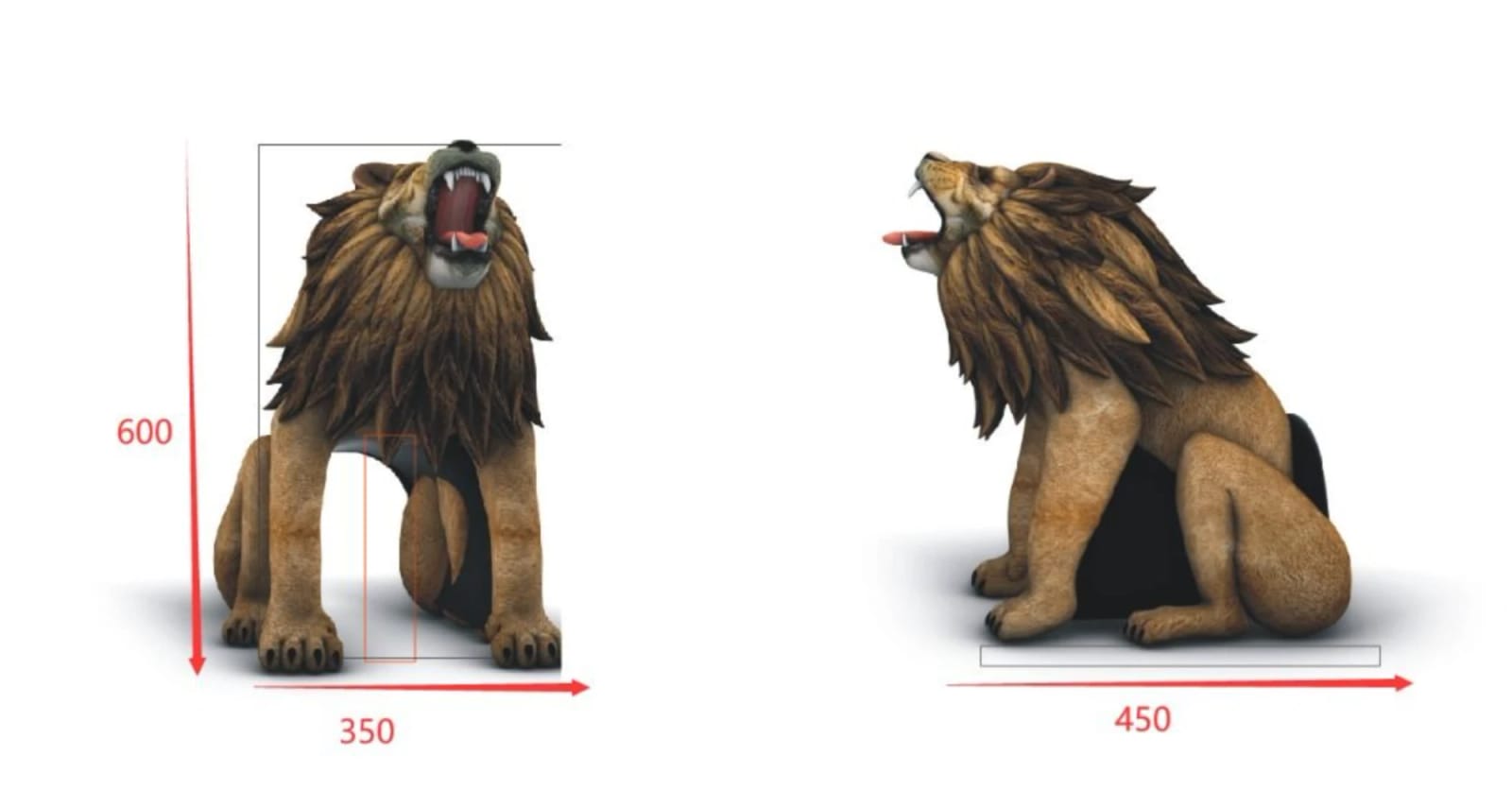
A custom inflatable starts with a brief and an approved 3D model, which is unfolded into digital patterns; the fabric is then printed, cut, sewn or welded, inflated for testing, checked, delivered and installed. For the ZSC lion tunnel, Digital Inflatables presented 3 proposals in 3D after 2 weeks, then laser-cut, sublimation-printed and hand-sewed more than 500 pieces of fabric.
Contents · 10 sections
How does a custom inflatable project start?
With an enquiry and a brief: the object, its size, the venue, the date, indoor or outdoor use and the budget, plus a sketch, a brand guide or a 3D file. The guide to briefing a custom inflatable lists the files and measurements to send.
For the Genève-Servette Hockey Club, the request came in mid-2022: a sport tunnel shaped like an eagle with outstretched wings.
For Buttonscarves, first contact was on 5 September, and the bag was delivered in London on 19 September 2023.
Commissioned by the city of Busan for its World Expo 2030 bid, the workshop proposed 2 concepts, and both were accepted.
Why make a 3D model before production?
Because 3D shows the shape, proportions, colours and lettering before a single piece of fabric is cut, and it then becomes the basis for the patterns.

For the ZSC lion tunnel, Digital Inflatables showed the club 3 proposals in 3D after 2 weeks; for the GSHC eagle, several 3D proposals followed the club’s brief.
For the LE CHAT replica made for Henkel, design and the 3D proof took 3 days.
For the Minion4 premiere at the Grand Rex, the workshop handled the design, the 3D, the production and the installation of a 6 m tall Minion.
A similar project? Describe it to our team.
Request a quoteWhen is the design signed off?
Before production starts: the client picks a 3D proposal or approves a proof, and that choice fixes the shape, colours and lettering to be printed.
For the GSHC, once the choice was made, the eagle tunnel was designed, cut and assembled in less than 10 days.
For Google, the 3D ideas for the 20 inflatable clouds were approved before production.
Changes after sign-off cost time: the guide to custom inflatable lead times shows what each stage takes.
What are the digital patterns of an inflatable?
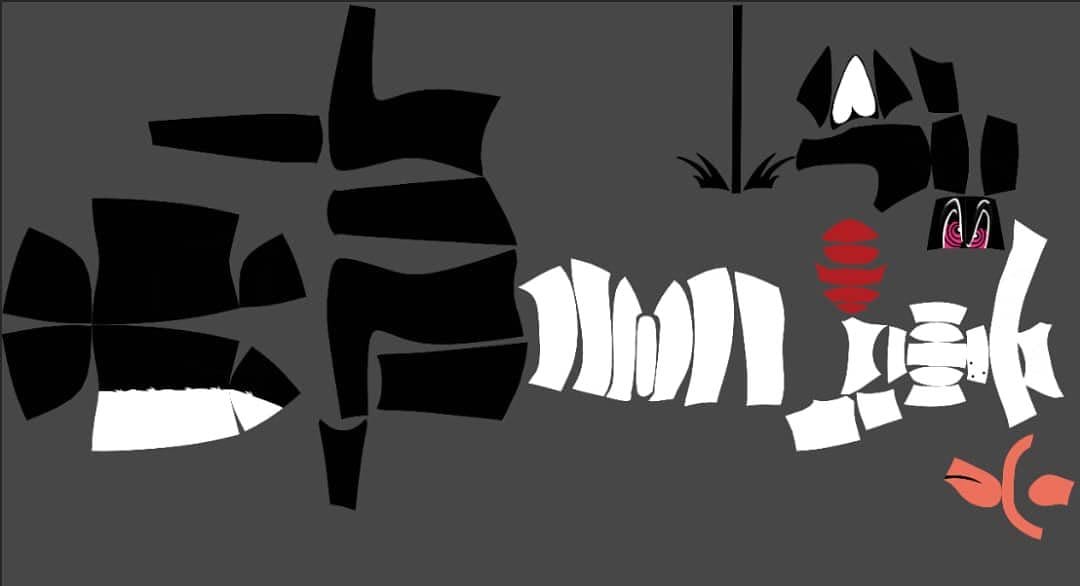
They are the flat fabric pieces unfolded from the 3D model: each volume is split into panels that are then printed, cut and joined.

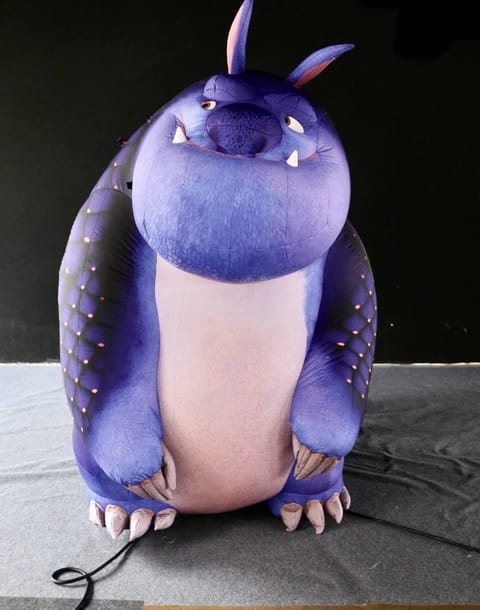
For the Spellbound monsters, made for the Netflix release, the workshop went from a complete 3D model to digital production templates, then to printing and cutting.
The giant cat for a DJ club in Miami went from 3D to plotter cut to the real object.
Sharp edges and flat faces call for finer patterns than a rounded volume, which follows the natural shape of an inflatable.
How is the fabric of an inflatable printed?
Either by dye sublimation on polyester, where ink printed on transfer paper is heat-pressed onto the fabric, or by UV printing, where the ink cures under UV light and also prints on PVC.

The Astra Festival moon was sublimation-printed, like the Buttonscarves giant bag, printed over its whole surface.
The LE CHAT replica received a high-definition UV print.
Fabric and branding choices are covered in the inflatable fabrics and printing guide.
How are the fabric pieces cut?
With a laser or a plotter, following the digital patterns; on polyester, a laser cuts and seals the edge in one process, and sealed edges prevent fraying.

For the ZSC and GSHC tunnels, more than 500 and more than 400 different pieces of fabric were laser-cut.
The giant Valentine’s Day hearts are made by digitising and laser cutting.
According to the machine maker Zünd, its laser module handles polyester fabrics up to 2 mm thick.
Sewing or welding: how are the pieces joined?
By sewing or welding: a shape kept inflated by a blower tolerates seams, while a sealed-air shape must stay airtight, which welding of coated fabrics makes possible.
The pieces of the ZSC and GSHC tunnels were sewn by hand; for the Spellbound monsters, each inflatable element joins 140 pieces of fabric.
In high-frequency welding, a field melts the plastic from the inside, between electrodes; the process suits PVC and PU.
Some fabrics take every method: at Michelin Inflatable, a PU-coated polyester certified M1 can be welded, heat-bonded or sewn.
How are the blower and inflation tested?
By inflating the object with its blower or pump to check the shape, the fabric tension and any leaks, and, for outdoor use, how it behaves in the wind.

Digital Inflatables put an inflatable astronaut through a wind test at 35 to 40 km/h.
The blower is sized to the volume: for the WAY agency moons, the workshop quotes just 120 watts.
A sealed-air object needs no blower: the LE CHAT replica inflates with a rechargeable 12 V pump, and the Buttonscarves bag combines blown air and sealed air. The constant-air vs sealed vs helium guide compares these methods.
What is checked before delivery?
The shape, the seams and welds, the colours, the blower and, for indoor use, the fire classification report of the fabric.

For its mirror balloons, Digital Inflatables ran its own flame test on top of the paper certificate.
The workshop also tests fabrics: a mirror fabric was tried on a moon and on a 2 m mirror ball.
The Astra Festival moon received an M1 fire-retardant treatment. Indoor fire ratings are explained in the inflatable fire rating guide.
How do delivery, set-up and installation work?
The inflatable travels folded and is inflated on site; depending on the venue, installation needs a crew, ballast, rigging points or a cherry picker, sometimes overnight.
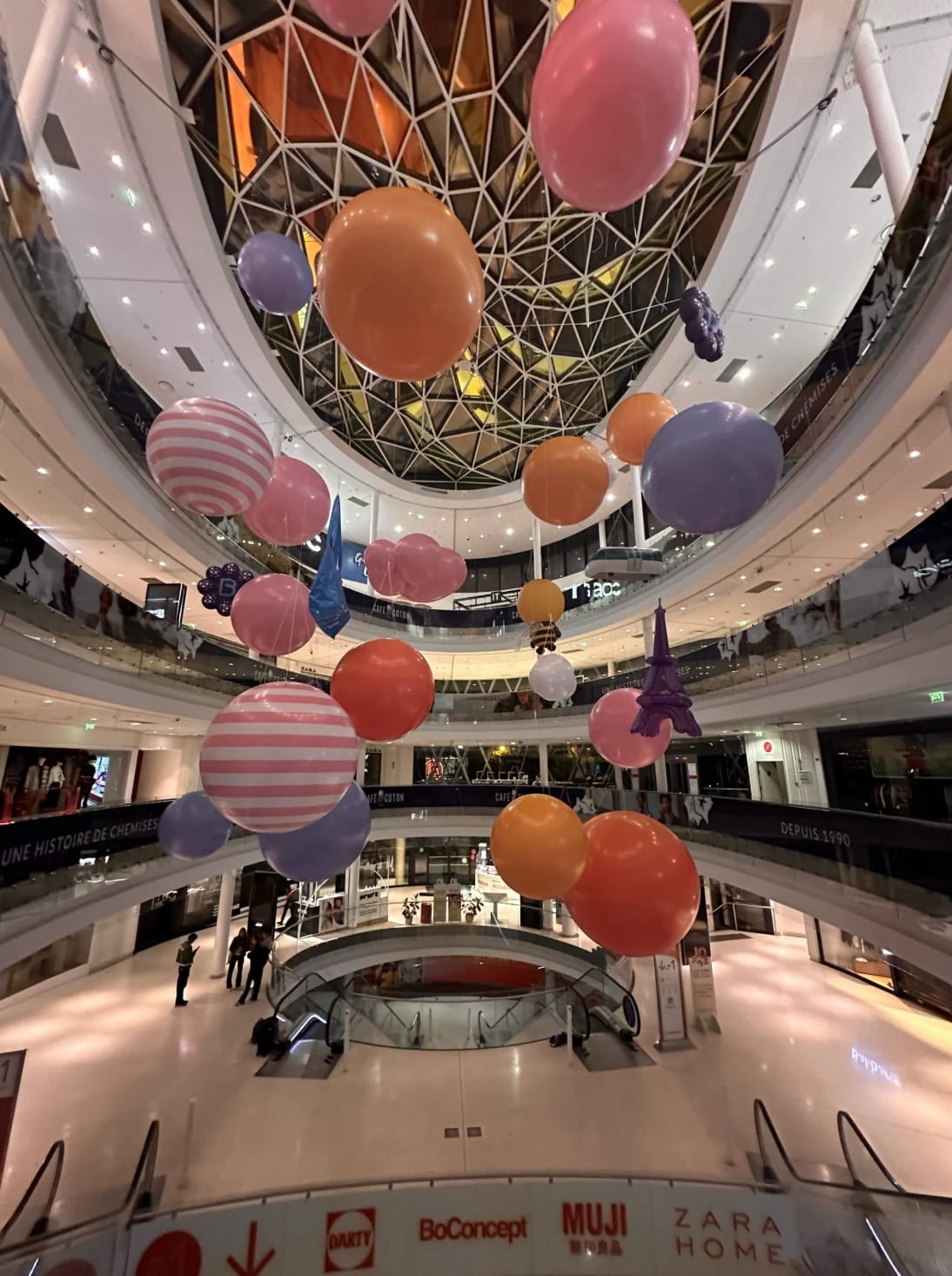
For the 10 years of the Beaugrenelle shopping centre in Paris, more than 30 inflatables made in 12 days were installed in 6 hours, overnight.
The three giant L214 chickens were set up in less than 1 h on the Place de la Bourse in Paris; the Grand Rex Minion went up the facade with rope access technicians and a cherry picker.
The Erborian stand fits, deflated, in a suitcase of less than 20 kg and sets up in less than 10 minutes. For wind, ballast and stakes, see the inflatables and wind guide.
Full specifications
| ZSC lion tunnel design | 3 proposals in 3D after 2 weeks |
|---|---|
| ZSC lion tunnel fabric pieces | more than 500, laser-cut, sublimation-printed and hand-sewn |
| Spellbound monsters | 140 fabric pieces per inflatable element |
| LE CHAT replica | design and 3D proof in 3 days |
| Beaugrenelle production | more than 30 inflatables in 12 days |
| Beaugrenelle installation | 6 hours, overnight |
Frequently asked questions
How long does it take to make a custom inflatable?
On Digital Inflatables projects: less than 10 days of production for the ZSC lion tunnel, after 2 weeks for the 3D, and 12 days for the Beaugrenelle inflatables. The lead times guide gathers more examples.
How much does a custom inflatable cost?
It depends on size, number of pieces and finish: 3’000 to 5’000 CHF for the Astra Festival moon, 40’000 to 50’000 CHF for more than 30 inflatables at Beaugrenelle. More budgets are in the custom inflatable prices guide.
Is a 3D file needed to order a custom inflatable?
No: a maker can start from a simple sketch or a written concept as well as from a detailed CAD file. Digital Inflatables, for example, modelled the giant cat for a Miami club in 3D itself.
Are inflatables sewn or welded?
It depends on the object: the pieces of the ZSC and GSHC tunnels were sewn by hand, while high-frequency welding joins materials such as PVC.
Can you see the inflatable before it is made?
Yes, in 3D: 3 proposals for the ZSC lion tunnel after 2 weeks, and a 3D proof in 3 days for the LE CHAT replica.
Are inflatables tested before use?
Digital Inflatables has tested an inflatable astronaut in 35 to 40 km/h winds, its mirror balloons with a flame, and a mirror fabric on a moon.
Sources
- Digital Inflatables projects page digital-inflatables.com
- Digital Inflatables Instagram post instagram.com
- Digital Inflatables Instagram post instagram.com
- Digital Inflatables Instagram post instagram.com
- Digital Inflatables Instagram post instagram.com
- Digital Inflatables Instagram post instagram.com
- Epson, dye-sublimation printers epson.eu
- Mimaki, UV-curable inks mimaki.com
- Zünd, laser module zund.com
- Kiefel, high-frequency welding kiefel.com
- Michelin Inflatable, structural fabrics inflatable.michelin.com
- Glow Inflatables FAQ glowinflatables.com
Drafted with AI assistance from the company’s verified facts, reviewed and approved by Jodoc Elmiger, founder and managing director of Digital Inflatables.